
Impact of Remote Therapeutic Monitoring in Inflammatory Bowel Disease (IBD)
Synchronyx has generated controlled clinical evidence at leading IBD centers and real-world evidence across oral, injectable, and infusion therapies.
Key Findings (ASSIST Study)
87% Mean Medication Adherence
94% Program Retention
83.5% Sustained Engagement
85% Patients Feeling Safer Under Monitoring
Interim findings from an ongoing 12-month multicenter randomized controlled trial.
High adherence of 80% or greater correlated with clinical improvement in validated PRO-2 disease activity scores.
Hear from the Experts
Dr Raymond Cross, Principal Investigator of the ASSIST study, describes the impact of remote monitoring for patients with IBD.

Dr Jordan Axelrad, co-investigator presents findings at the ACG Meeting.
Front Line News: Using Technology to Manage IBD.
The Clinical Problem
IBD therapy today spans daily oral agents, home-administered subcutaneous injectables, and scheduled intravenous infusions. Each route carries its own dosing complexity, access barriers, and patient experience challenges. Across published studies, overall adherence to IBD medications ranges from 40% to 80% depending on drug class, route, and measurement method. In a survey of more than 300 IBD patients, 55% reported nonadherence, most commonly forgetting doses or discontinuing therapy during asymptomatic periods when the perceived need diminished.
The clinical and commercial consequences are well established. Suboptimal adherence is associated with increased disease activity, worsened quality of life, and higher healthcare utilization and costs. For patients on biologic therapies, missed doses carry an additional and specific risk: the development of antidrug antibodies that can lead to loss of therapeutic response and necessitate treatment escalation to more complex or costly regimens.
The monitoring gap compounds the adherence problem. Patients initiating a new subcutaneous therapy at home may encounter specialty pharmacy access delays, injection anxiety, or early tolerability issues that go unreported until the next scheduled clinic visit. Patients attending infusion sessions face scheduling and authorization barriers that create therapy gaps invisible to the clinical team in real time. Refill data confirms a prescription was dispensed. It does not confirm doses were taken, when they were missed, or why.
Managing IBD at home means navigating complex treatment schedules, unpredictable symptoms, and long stretches between clinic visits.
Patients on Tappt report feeling safer under monitoring, more supported between visits, and more in control of their own care.
How Tappt Works Across IBD Therapy
Managing IBD means managing complexity across oral therapies, home injections, and infusion center visits, each with different schedules and different barriers.
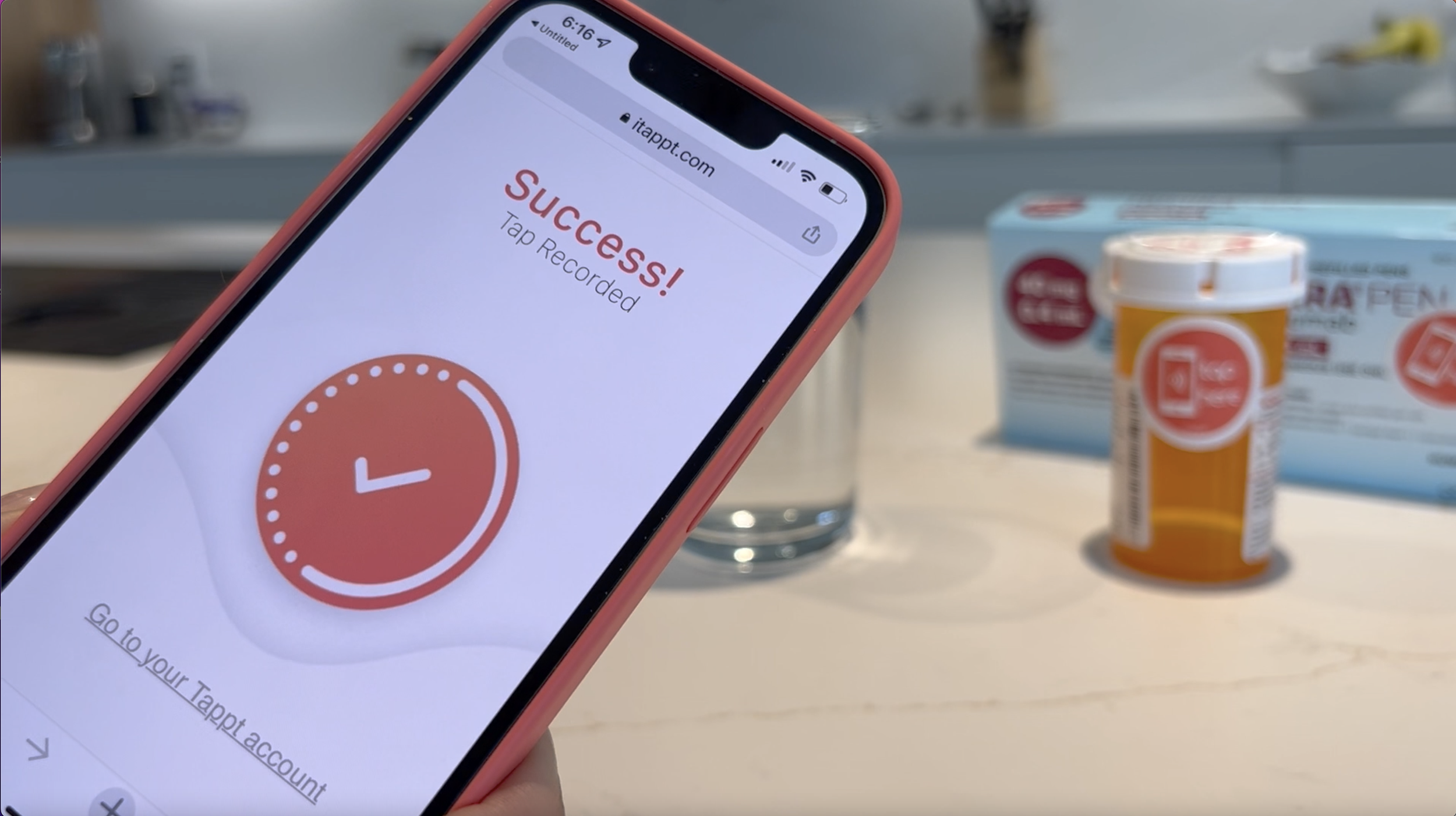
Tappt travels with the medication. A smart label attaches to the pill bottle, blister pack, injection box, or infusion smart card. A tap records the dose. A reminder arrives when the next one is due. If a dose is missed, the patient is asked why, and the care team is notified when the answer matters.
The result is real-time visibility across every mode of IBD administration, without adding burden to patients or clinical workflows.
The ASSIST Study
ASSIST (A Novel Remote Patient and Medication Monitoring Solution to Improve Adherence and Persistence With Inflammatory Bowel Disease Therapy) is a 12-month multicenter randomized controlled trial evaluating Tappt's effectiveness on medication adherence, clinical outcomes, and healthcare use among patients with IBD initiating a new oral or subcutaneous therapy. The trial randomizes patients 2:1 to Tappt versus standard of care.
The ASSIST study is the first prospective randomized controlled trial of a smart label-enabled remote therapeutic monitoring intervention in IBD, designed to generate the highest level of clinical evidence with outcomes including medication possession ratio, validated PRO-2 disease activity scores, and composite healthcare utilization endpoints assessed at 12, 26, and 52 weeks.
Interim findings have been presented at the ACG Annual Scientific Meeting 2024 and the American Telemedicine Association Annual Meeting 2025, with award recognition at both conferences.
Supported by: The Crohn's and Colitis Foundation Clinical Investigator Research Award and the NIH National Institute of Diabetes and Digestive and Kidney Diseases (K23DK124570).
ClinicalTrials.gov ID: NCT05316584. View registration →
Participating centers: University of Maryland · Mercy Medical Center · NYU Grossman School of Medicine · University of North Carolina · Vanderbilt University · University of Cincinnati.
MONITOR Study
The MONITOR trial is a multi-center registered clinical study evaluating efficacy and adherence to subcutaneous versus intravenous vedolizumab in IBD patients using Tappt real-time remote monitoring. Conducted across 7 IBD centers, it is the first study to generate objective comparative adherence and persistence data across two administration routes of the same therapy using a unified digital monitoring platform.
For pharmaceutical organizations evaluating real-world evidence strategies across administration modalities, MONITOR represents a direct proof of concept for Tappt as infrastructure for comparative effectiveness and persistence research in IBD.
Supported by: Takeda Pharmaceuticals.
ClinicalTrials.gov ID: NCT06750731. View registration →
Publications and Presentations
Peer-reviewed publication: Axelrad J, Long M, Horst S, Afzali A, Sapir T, Fajardo K, De Felice K, Sandler R, Cross R. A Novel Remote Patient and Medication Monitoring Solution to Improve Adherence and Persistence With Inflammatory Bowel Disease Therapy (ASSIST Study): Protocol for a Randomized Controlled Trial. JMIR Research Protocols. 2022;11(12):e40382. Read the full paper →
Award-Winning Presentation, ACG Annual Scientific Meeting 2024: Axelrad J, Sapir T, Horst SN, DeFelice K, Afzali A, Abdelrehem A, Noyes A, Anderson C, Long MD, Cross RK. A Novel Remote Patient and Medication Monitoring Solution to Improve Adherence and Persistence With Inflammatory Bowel Disease Therapy: Updates From the ASSIST Study. The American Journal of Gastroenterology. 2024;119(10S):S865-S867. Read the abstract →(Institutional access may be required)
Award-Winning Presentation, American Telemedicine Association Annual Meeting 2025: Axelrad J, Sapir T, Horst S, DeFelice K, Afzali A, Noyes A, Abdelrehem A, Anderson C, Long M, Cross R. A Novel Remote Patient and Therapeutic Monitoring Solution to Improve Adherence and Persistence with Inflammatory Bowel Disease Therapy: Updates from the ASSIST Study. American Telemedicine Association Annual Meeting, 2025.
Active registered trial: MONITOR Study: Study of Efficacy and Adherence to Subcutaneous vs. Intravenous Vedolizumab in Patients with IBD Using a Novel Remote Monitoring Intervention. ClinicalTrials.gov ID: NCT06750731. View registration →
In the Press
HCPLive: Dr. Jordan Axelrad, MD, MPH on Addressing Nonadherence to IBD Therapies with Remote Monitoring. Read the feature →
University of Maryland: New Clinical Trial Will Test Remote Monitoring to Better Manage Inflammatory Bowel Disease. Read the announcement →