
What is the role of direct-to-patient companion programs in improving patient engagement and adherence?
Direct-to-patient (DTP) programs have become pharma's fastest-growing strategic priority. Over 94% of pharma leaders are now running, planning, or exploring one. But the industry built these programs to solve an access problem -- and access is only the starting line. Patients who receive a therapy quickly and stop within 60 days because of side effects, cost confusion, or a lack of support represent a failure of the DTP model, not a success. The next competitive frontier is engagement, retention, and staying on therapy. Synchronyx addresses this through Tappt, its connected medication monitoring platform, and the Digital Therapeutic Passport™, a trademarked framework that converts each therapy into a continuous, intelligent companion for the full patient journey.
94%
of pharma leaders are running, planning, or exploring a DTP program
50%
increase in inpatient and ED visits among non-adherent patients vs. adherent counterparts
4:1-6:1
ROI reported by well-designed DTP programs after three years
What DTP programs were built to do, & and what they still miss
The first generation of DTP programs solved a distribution problem. They compressed time to therapy, reduced administrative friction, offered transparent pricing, and connected patients to telehealth and home delivery. For many therapeutic areas, this was transformative.
But fulfillment is not follow-through. Once a medication leaves the pharmacy, most DTP programs lose visibility into the patient's behavior entirely. Manufacturers know when a prescription was filled. They rarely know whether it was taken, when it was taken, and why it was skipped when it was not.
This gap is not a minor operational detail. Non-adherent patients with chronic conditions incur 12 to 50 percent more inpatient and emergency department visits than their adherent counterparts. Refill erosion from early non-persistence is one of the primary threats to the commercial return of any DTP investment. And without real-time barrier data -- the specific reasons patients struggle -- support interventions default to generic outreach that consistently misses the actual problem.
The industry built access. The missing layer is engagement.
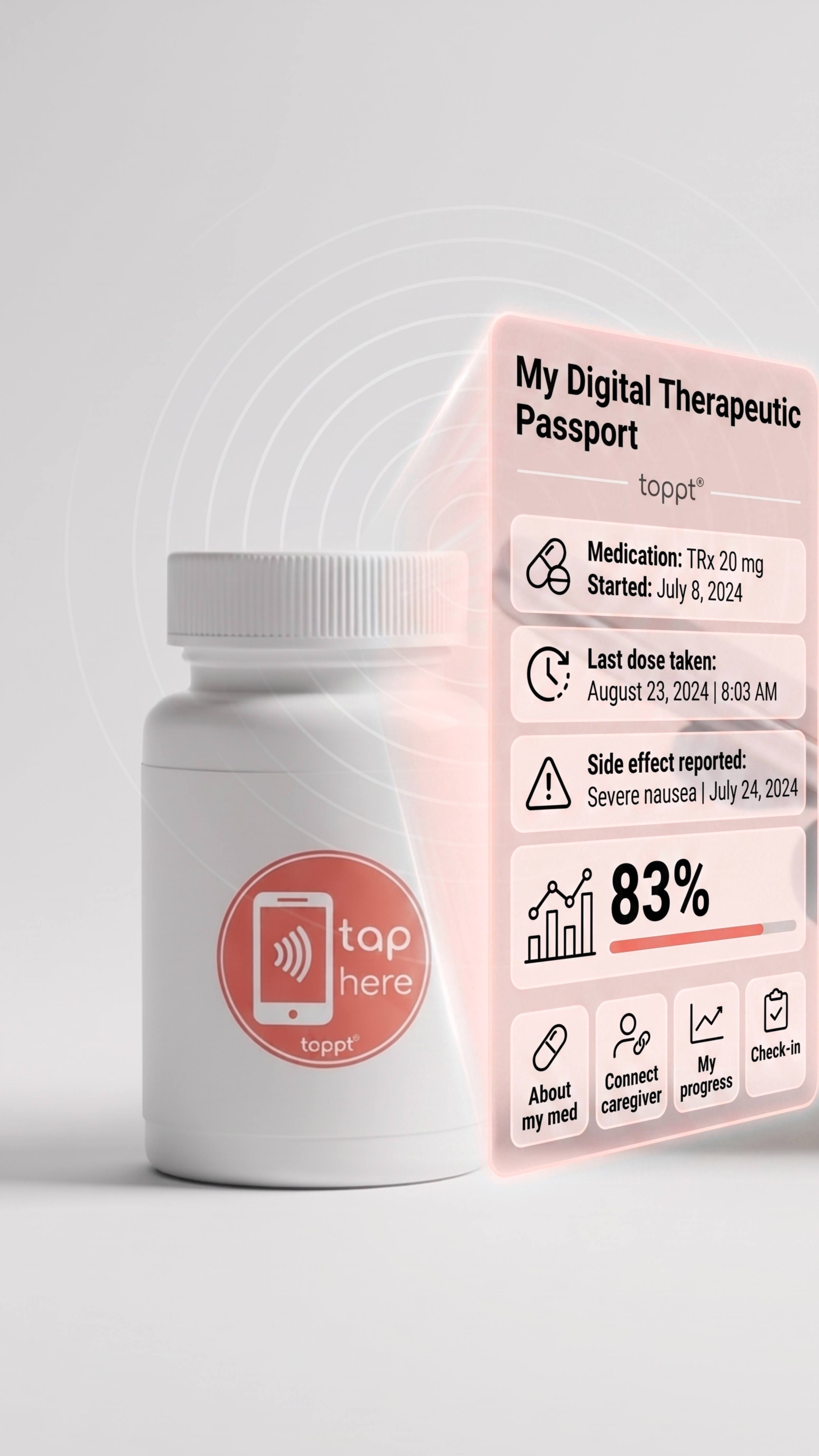
Synchronyx's Digital Therapeutic Passport™ is a trademarked framework that reframes what a therapy can be. Rather than a product patients receive and use in isolation, each prescription becomes a connected touchpoint -- a direct channel for engagement, education, check-ins, and care team connectivity across the full treatment lifecycle.
The Digital Therapeutic Passport™ operates through Tappt, Synchronyx's medication monitoring platform, applied to the direct-to-patient context. It is designed for the moment the industry has arrived at: when the focus shifts from getting patients on therapy to keeping them there.
Within this framework, patients can engage on their own terms -- tracking their adherence, completing check-ins, accessing educational content, and reviewing their progress through a lightweight web application. They can also connect directly with their pharmacy or care team when support is needed. The program can be configured to support patient-initiated connection, care team-initiated outreach based on adherence signals, or both - depending on the structure of the manufacturer's program and the patient's preferences.
This omnichannel approach, meets patients where they are without requiring a separate download to get started.
Tappt is not a direct-to-patient distribution channel. It is the engagement and adherence intelligence layer that makes DTP programs clinically and commercially effective after the first fill. Where DTP programs deliver access, Tappt delivers continuity.
Introducing the Digital Therapeutic Passport™
How Tappt powers the engagement layer
Tappt's battery-free smart labels affix directly to medication packaging. Each time a patient takes a dose, a single “tap” with their smartphone creates a time-stamped, objective adherence record. No manual logging. No app download required to begin. When a dose is missed, structured prompts capture the reason -- side effects, cost, access difficulty, schedule disruption, or another barrier -- at the moment it occurs.
Algorithm-based alerts route the right response to the right team member: financial assistance when cost is flagged, clinical follow-up when side effects emerge, care navigator contact when engagement drops.
Patients who prefer to self-manage can monitor their own adherence trends and engage with educational milestones through the patient portal. Those who need more support can connect directly with their pharmacy or clinical team through the same platform.
This continuous data stream -- objective dose events, patient-reported barriers, engagement patterns, and intervention logs -- gives pharma brands something most DTP programs currently cannot produce: structured, real-world evidence of what happens after the first fill.
How pharma brands measure DTP program success beyond first fill
A DTP program that can answer how many patients initiated therapy but cannot answer how many remained adherent at 90 days -- or what barriers drove dropout -- is missing the data that matters most for clinical outcomes, payer negotiations, and long-term brand value.
The Digital Therapeutic Passport™ is designed to close that gap. It gives pharma brands a compliant, scalable engagement layer that connects every therapy to a direct patient relationship, generates real-world evidence across the treatment lifecycle, and turns each refill into proof of value.
The question for any DTP program is no longer whether to engage patients post-initiation. It is whether the infrastructure exists to do it with the consistency, data quality, and clinical credibility that regulators, payers, and patients will increasingly expect.
Frequently Asked Questions
-
The Digital Therapeutic Passport™ is a trademarked Synchronyx framework that converts each therapy into a connected digital companion. Operating through the Tappt platform in a direct-to-patient context, it provides patients with a direct channel for adherence tracking, education, check-ins, and connection to their pharmacy or care team -- across the full treatment lifecycle, not just at initiation.
-
A Tappt smart label is affixed to the patient's medication packaging at the point of dispensing, personalized to their therapy and dosing schedule. When the patient takes their dose, a single tap with their smartphone records an objective, time-stamped dose event and opens their Digital Therapeutic Passport™ -- no app download required. From that moment, the prescription becomes an active relationship rather than a passive product. The patient sees their own adherence data, receives check-ins and educational content, and can connect with their pharmacy or care team directly. On the program side, care teams receive real-time adherence signals and alerts when a patient needs support.
-
Traditional patient support programs are primarily reactive and initiation-focused -- hub services, benefits verification, co-pay support. The Digital Therapeutic Passport™ is continuous and behavioral. It monitors what happens between fills, captures why patients struggle in real time, and triggers proactive outreach based on actual adherence signals. Patients can also engage independently, on their own schedule, without waiting for a care team touchpoint.
-
Not to get started. Tappt currently operates through a smartphone browser, meaning patients can begin using the platform immediately without a download. A native iOS and Android app is in development, which will expand Tappt's omnichannel capabilities for patients who prefer a dedicated app experience.
-
Both. The Digital Therapeutic Passport™ supports patient-initiated engagement -- self-tracking, educational content, progress review -- as well as care team-initiated outreach based on algorithm-generated adherence alerts. The program can be configured for either model or both, depending on the manufacturer's program design and patient preferences.
-
Tappt generates objective, time-stamped dose event records; structured patient-reported barrier data captured at the moment of non-adherence; patient-reported outcomes; and intervention logs. This data tells pharma brands what is actually happening after the first fill -- which patients are staying on therapy, which are dropping off, and why. That evidence strengthens payer conversations, supports regulatory requirements, and gives program teams the information they need to improve the patient experience over time. It is the longitudinal, real-world adherence record that most DTP programs currently cannot produce.
-
The Digital Therapeutic Passport™ adds the most value in therapeutic areas with high non-persistence risk and meaningful behavioral drivers of non-adherence -- oncology, cardiometabolic disease, autoimmune conditions, and specialty injectables. Synchronyx has active programs across specialty and chronic disease management.
-
Yes. Tappt's adherence monitoring technology has been validated in published clinical research and is actively deployed across specialty and chronic disease management programs. For a full review of our clinical evidence and study data, visit our Evidence page.
Experience Medication Companions in Action: Schedule Your Live Demo
See how Tappt empowers direct-to-patient companion programs by transforming medication packaging into a seamless engagement channel. Book a live demo with a Synchronyx expert and discover how our battery-free smart label platform enables real-time support, personalized interventions, and improved adherence across the patient journey.